Thursday, June 8, 2023

Climate Parable: The Helmet of Bees

This little poem comes from the emblems of Alciato which you can read online at this marvelous website at the University of Glasgow: Alciato at Glasgow, and all the images below come from the Glasgow site. For more about Alciato (1492-1550), see Wikipedia: Alciato. This is the first of what will be a series of climate parable posts here at the blog.

In his time, Alciato was responding to the devastation of war, using this helmet-hive as an emblem of peace. For us now, even when we are "at peace," the military industrial complex is destroying our planet. For more about that, see, for example, this paper from the Watson Institute at Brown University: Costs and Consequences of US Post-9/11 Wars: Focus on Climate Change.  

For a modern helmet parable, see this cartoon: Peace on Earth. (Thanks so much to Patrick D. for that one!)

And now, here's Alciato's poem and emblematic image: peace, not war! beehives, not helmets! I've included an English translation and help with the Latin meter too. :-)


EX BELLO PAX

En galea, intrepidus quam miles gesserat, et quae
Saepius hostili sparsa cruore fuit:
Parta pace apibus tenuis concessit in usum
Alveoli, atque favos, grataque mella gerit.
Arma procul iaceant: fas sit tunc sumere bellum
Quando aliter pacis non potes arte frui.


From War, Peace. Behold the helmet which a fearless soldier bore and which so often was sprinkled with enemy gore; now in the time of peace it has yielded its confined space to the bees for use as a hive, bearing honeycombs and welcome honey. Let weapons be set down at a distance; it is your sacred duty to  resume war only then when you cannot enjoy peace by any other means.

For those of you who love Latin poetry (I do!), here is a bit of help with the elegiac meter with the elisions and feet marked:

En gale~ · intrepi·dus quam · miles · gesserat, · et quae
   Saepius · hosti·li || sparsa cru·ore fu·it:
Parta · pac~ api·bus tenu·is con·cessit in · usum
   Alveol~ · atque fav·os || grataque · mella ge·rit.
Arma pro·cul ia·ceant: · fas sit · tunc sumere · bellum
   Quand~ ali·ter pa·cis || non potes · arte fru·i.


Monday, May 29, 2023

Phaedrus: Mons Parturiens


This project has moved to a blog of its own: Fabulae Aesopi.
This is the collection of Latin fables that started it all: Phaedrus! You can read more about Phaedrus at Wikipedia.

4.22 Mons Parturiens

Mons parturibat, gemitus immanes ciens,
eratque in terris maxima expectatio.
At ille murem peperit. Hoc scriptum est tibi,
qui, magna cum minaris, extricas nihil.

Here is the poem written out in English prose order to help in reading:

Mons parturibat, 
ciens immanes gemitus,
et 
in terris
erat maxima expectatio.
At ille (mons)
peperit murem. 
Hoc scriptum est tibi,
qui,
cum minaris magna,
extricas nihil.

This famous fable is also found in Horace, and it has its own Wikipedia article.

The meter is iambic:

Mons par·turi·bat, gemi·tus im·manes · ciens,
erat·qu~ in ter·ris max·im~ ex·pecta·tio.
At il·le mu·rem pepe·rit. Hoc · script~ est · tibi,
qui, mag·na cum · mina·ris, ex·tricas · nihil.

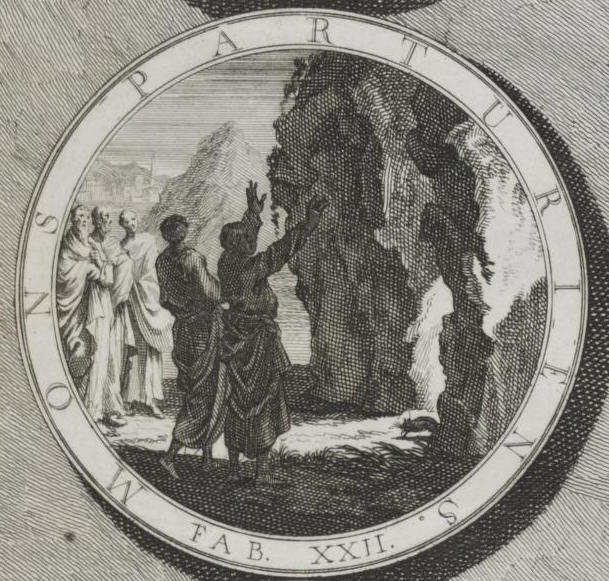
Here is an illustration from a 1701 edition of Phaedrus:


Saturday, May 20, 2023

Faernus: Vulpes et Uva


This project has moved to a blog of its own: Fabulae Aesopi.
This is one of the 100 Aesop's fables in verse by the Renaissance scholar and poet Faernus (Gabriello Faerno). You can read more about Faernus at Wikipedia, and here are all the Faernus poems I have posted at this blog.

19. Vulpes et Uva

Vulpes esuriens   alta de vite   racemos
Pendentes   nulla cum prensare arte valeret,
Nec pedibus tantum   aut agili se tollere saltu,
Re infecta      abscedens,   haec secum,   "Age desine!" dixit,
"Immatura uva est    gustuque insuavis acerbo."
Consuevere homines,   eventu si qua sinistro
Vota cadunt,   iis sese alienos   velle videri.

Here is the poem written out in English prose order to help in reading:

Esuriens vulpes,
cum non valeret 
ulla arte
prensare racemos
pendentes de alta vite,
et non [valeret] tollere se
pedibus tantum
aut agili saltu,
re infecta,
abscedens, 
dixit haec secum,
"Age desine!
Uva est 
immatura
et insuavis,
gustu acerbo."
Homines consuevere, 
si qua vota cadunt
sinistro eventu, 
velle 
sese videri 
alienos iis.

This is a famous Aesop's fable (Perry 15), and it's where we get the phrase "sour grapes," meaning the way a person disparages something that they actually want but cannot get.

The meter is dactylic hexameter (Faernus used a variety of meters).

Vulpes · esuri·ens al·ta de · vite ra·cemos
Penden·tes nul·la cum·prensar~ · arte va·leret,
Nec pedi·bus tant~ · aut agi·li se · tollere · saltu,
R~ infec·t~ absce·dens, haec · sec~ "Age · desine!" · dixit,
"Imma·tur~ uv~ · est gus·tuqu~ in·suavis a·cerbo."
Consue·ver~ homi·nes, e·ventu · si qua si·nistro
Vota ca·dunt, iis·ses~ ali·enos·velle vi·deri.

There are several illustrated editions of Faernus, and here is one of the illustrations for this poem (online at the Internet Archive):