Wednesday, May 3, 2023

Aesopi Carmina: Desbillons Book 5


This project has moved to a blog of its own: Fabulae Aesopi.
This continues my series of posts about the Latin verse fables of Desbillons; for more about Desbillons, see the starting post. I'm working through the poems book by book, and this is the post for Book 5, well on the way now to Book 15! 

For each book, I'm including one poem in the blog post. So, you'll find a poem-by-poem index to Book 5 below (linking to the pages at the Internet Archive), and here's the poem I selected from that book, just 5 lines long. This is actually one of my favorite fables! It's not in the classical Aesopic corpus; instead, this is another of the fables that Desbillons took from the Renaissance fabulist Abstemius (for another story from Abstemius, see the dog and the horse from Book 2).

V.20 Cera et Later

Cera invidebat Lateri duritiem suam,
Quam comparari ab ignium violentia
Cum comperisset, se ipsa in ignes dejicit,
At misera penitus liquitur et consumitur.
Quod uni prodest, alteri saepe id nocet.

Here is the poem written out in English prose order to help in reading:

Cera
invidebat Lateri
duritiem suam. 
Cum [Cera] comperisset
duritiem comparari
ab violentia ignium,
ipsa dejicit se
in ignes,
at misera [Cera]
penitus liquitur
et consumitur.
Saepe id
quod prodest uni,
nocet alteri.

This theme of "foolish imitation" shows up again and again in Aesop's fables, but less commonly with inanimate objects as you see here with the candle and the brick.

The meter is iambic, and here is some help with the meter (for more about iambic meter, see the post about Desbillons 1.1). The moral in the last line is a great iambic line to practice saying out loud to get a feel for the meter since it has no substitutions and just one elision (saepe-id).

Cer~ in · vide · bat Late · ri du · ritiem · suam,
Quam com · parar~ · ab ig · nium · violen · tia
Cum com · peris · set, s~ ips~ · in ig · nes de · jicit,
At mise · ra peni · tus liqui · tur et · consu · mitur.
Quod u · ni pro · dest, al · teri · saep~ id · nocet.

This story appears in the fables of the French poet Jean de La Fontaine, which means you can find illustrations in editions of his poems. One of La Fontaine's most famous illustrators was Grandville, and you can see Grandville's illustration here in a graphic I made with imgflip:


More poems in Desbillons, Book 5:

1. camelus (lines: 10)
2. viator et lapides (lines: 11)
3. vulpis et cervus (lines: 12)
4. carbonarius et fullo (lines: 6)
5. cervus et vitis (lines: 12)
6. canis et vulpis (lines: 5)
7. ager in quo thesaurus (lines: 16)
8. venator, palumbes, et cornix (lines: 9)
9. equulus et equus (lines: 20+)
10. gallina et ova crocodili (lines: 5)
11. vulpis et rubus (lines: 6)
12. piscator et thunnus (lines: 6)
13. delphinus et simius (lines: 18)
14. fures et gallus (lines: 7)
15. corvus, asellus, et agaso (lines: 10)
16. amnis et fons (lines: 11)
17. culex et taurus (lines: 6)
18. simia et nux (lines: 5)
19. sus opima (lines: 5)
20. cera et later (lines: 5)
21. lupus et mulus (lines: 14)
22. fluvii duo (lines: 14)
23. pica et columba (lines: 7)
24. avarus et eius filius (lines: 15)
25. arbores (lines: 5)
26. edera et agricola (lines: 20+)
27. piscis fluviatilis et pisces marini (lines: 12)
28. bubulcus et Hercules (lines: 10)
29. simia, porcus, et vulpis (lines: 10)
30. leo et musculus (lines: 14)
31. asellus onustus sale (lines: 11)
32. cucurbita et arbor (lines: 14)
33. lepus et testudo (lines: 20+)
34. Jupiter, Modestia et Virtutes ceterae (lines: 13)
35. caseus et felis (lines: 6)
36. lupi fides (lines: 9)
37. vulpis et ericius (lines: 14)
38. olitor et sepes (lines: 6)
39. alba spina et ficus (lines: 13)
40. sol et noctua (lines: 5)
41. amygdala et pyrus (lines: 8)
42. agricola et arbores (lines: 14)
43. catellus, ovis, et cuniculus (lines: 9)

Tuesday, May 2, 2023

Aesopi Carmina: Desbillons Book 4


This project has moved to a blog of its own: Fabulae Aesopi.
Here is the latest in a series of posts about the Latin fable poems by Desbillons; for more about Desbillons, see the first post. I'm working through all the poems book by book with indexes that link to each of the individual fables in each book; this is the post for Book 4.

In addition, I am picking out one very short poem as the focus. So, you'll find a poem-by-poem index to Book 4 below (linking to the pages at the Internet Archive), plus the poem I selected from that book; it's actually the first poem in the book, and it's just 4 lines long. You can find this fable in the classical Greek Aesop.

IV.1 Sus et Leaena

Fecunda Sus Leaenae vertebat probro,
Catulum quod unum quolibet partu ederet.
"Unum, at Leonem," retulit indignans fera.
Res dignitate praevalent, non copia.

Here is the poem written out in English prose order to help in reading:

Fecunda Sus 
vertebat Leaenae
probro,
quod 
quolibet partu
ederet unum Catulum.
Indignans fera retulit,
"Unum, at Leonem."
Res praevalent
dignitate,
non copia.

As you can see, the moral is what we would call "quality, not quantity" in English, "dignitas, non copia" in Latin.

The meter is iambic, and here is some help with the meter (for more about iambic meter, see the post about Desbillons 1.1).

Fecun · da Sus · Leae · nae ver · tebat · probro,
Catulum · quod u · num quo · libet · part~ e · deret.
Un~ at · Leo · nem re · tulit in · dignans · fera.
Res dig · nita · te prae · valent · non co · pia.

In most English-language versions of this fable, it is a fox who debates with the lioness and is rebuked, but in the classical Greek Aesop, the dialogue is between a sow and a lioness, which is the version that Desbillons has adapted. Here is an English version of the fable in Townsend, with an illustration by Oliver Herford:

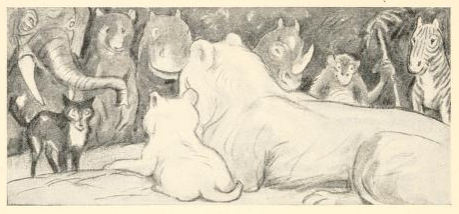
A CONTROVERSY prevailed among the beasts of the field as to which of the animals deserved the most credit for producing the greatest number of whelps at a birth. They rushed clamorously into the presence of the Lioness and demanded of her the settlement of the dispute. 'And you,' they said, 'how many sons have you at a birth?' The Lioness laughed at them, and said: 'Why! I have only one; but that one is altogether a thoroughbred Lion.'
The value is in the worth, not in the number.


More poems in Desbillons, Book 4:

1. sus et leaena (lines: 4)
2. puer, et passer fugitivus (lines: 15)
3. pastor et mare (lines: 14)
4. leo, asinus, et vulpis (lines: 10)
5. musculus et felix (lines: 14)
6. invidus et avarus (lines: 19)
7. gallus, asinus, et leo (lines: 20+)
8. milvus, corvus, et aquila (lines: 20+)
9. equus et lupus (lines: 20+)
10. leaena et ovis (lines: 11)
11. vir sapiens et eius inimicus (lines: 11)
12. catella (lines: 20+)
13. rusticus et asinus (lines: 20+)
14. musca, trochilus, et trossulus (lines: 15)
15. avarus et thesaurus (lines: 8)
16. lupus filium erudiens (lines: 20+)
17. vulpis sine cauda (lines: 20+)
18. mustela et mures (lines: 9)
19. puer et colonus (lines: 20+)
20. anicula et eius ancillae (lines: 13)
21. vulpis, asinus, et leo (lines: 13)
22. milvus aegrotans (lines: 11)
23. pardus et vulpis (lines: 8)
24. deus ligenus (lines: 15)
25. iuvenes duo et ursus (lines: 20+)
26. bos et equus (lines: 20+)
27. puer et turbo (lines: 5)
28. leo, agnus, et cerva (lines: 14)


Monday, May 1, 2023

Aesopi Carmina: Desbillons Book 3


This project has moved to a blog of its own: Fabulae Aesopi.
This continues my series of posts about the Latin verse fables of Desbillons; for more about Desbillons, see the starting post. I'm working through the poems book by book with indexes to each of the individual fables; this is the post for Book 3.

For each book, I am picking out one very short poem as the focus. So, you'll find a poem-by-poem index to Book 3 below (linking to the pages at the Internet Archive), and here's the poem I selected from that book, just 3 lines long, and it belongs to the classical Aesopic tradition.

3.20 Auceps, Palumbus, et Serpens

Dolum Palumbo incautus Auceps dum struit,
Premit anguem, cujus dente violatus perit.
Malum jure feres, quod parabis alteri.

Here is the poem written out in English prose order to help in reading:

Incautus Auceps,
dum struit dolum Palumbo,
premit anguem, 
cujus dente violatus
perit.
Jure
feres [hoc] malum
quod parabis alteri.

Even though Palumbo is capitalized, the bird does not actually make an appearance in the story (at least not in this version!), while the snake is not capitalized ("anguem") so that it becomes more of an object rather than a proper character in the story. I'm not sure what I think about that; in fact, I'd be inclined to go the other way and write "Anguem" capitalized and "palumbo" lower-case. Those conventions will be something to ponder as this anthology takes shape, since I think it would be good to follow a similar convention across the different story-poems even when they are coming from different sources.

The "au" in "auceps" is a shortened form of "avis" in the sense that he is the bird-catcher (avis-capere). You can read about the bird called "palumbus" at the Wiktionary, which features this picture:


The meter is iambic, and here is some help with the meter (for more about iambic meter, see the post about Desbillons 1.1).

Dolum · Palum · b~ incau · tus Au · ceps dum · struit,
Premit an · guem, cuj · us den · te vio · latus · perit.
Malum · jure fe · res, quod · para · bis al · teri.

You can find illustrations for the fable here. Here's one from the Medici Aesop, and I used imgflip to make it a graphic:


More poems in Desbillons, Book 3:

1. sol et aquilo (lines: 15)
2. agricola et ciconia (lines: 14)
3. piscator et pisciculus (lines: 7)
4. membra et venter (lines: 15)
5. canis et bos (lines: 7)
6. puer et fortuna (lines: 4)
7. camelus et Iupiter (lines: 8)
8. lupus et haedus (lines: 8)
9. oves et lupi (lines: 10)
10. vulpis et caper (lines: 20+)
11. mulier et gallina (lines: 7)
12. cancer et vulpis (lines: 7)
13. musicus (lines: 11)
14. asinus et canis (lines: 20+)
15. bos et vitula (lines: 6)
16. leo filiam rustici amans (lines: 16)
17. culex, leo et aranea (lines: 16)
18. columbae et accipiter (lines: 7)
19. simia et vulpis (lines: 8)
20. auceps, palumbus, et serpens (lines: 3)
21. asellus eiusque herus (lines: 9)
22. taurus et caper (lines: 11)
23. corvus et urna (lines: 7)
24. venator et leo (lines: 11)
25. corvus et serpens (lines: 8)
26. rustici et sarmenta (lines: 8)
27. avis, eiusque pulli, et villicus (lines: 15)
28. crocodilus et vulpis (lines: 5)
29. ursus, leo, et lupus (lines: 16)
30. asinus dominos mutans (lines: 19)
31. aper et cerva (lines: 9)
32. asinus et equus (lines: 11)
33. Aethiops (lines: 11)
34. muscae (lines: 6)
35. vespertilio et mustelae duae (lines: 20+)
36. haedus et lupus (lines: 6)
37. tubicen et hostes (lines: 11)
38. accipiter et cuculus (lines: 14)
39. capones duo (lines: 16)
40. aranea et hirundo (lines: 18)
41. vulpis et ericius (lines: 14)
42. struthiocamelus altum volandi cupidus (lines: 12)